


Sound reduction is measured in STC, which stands for Sound Transmission Class. It ranges from 0-100 – with 100 representing complete soundproofing and 0 representing no barrier between you and the sound. For example, when a window is open, you’re at 0 STC, hearing all the sounds from outside. When you close the window, you hear the sound through a barrier (glass), and the glass has an STC rating, indicating how much sound has been reduced. For a more scientific explanation of STC please see STC Ratings.
Sound is measured in decibels (dB). Most people can begin hearing the faintest sounds at 0 decibels. In real life, these instances are rare, as we’re constantly exposed to some level of sound. Even in quiet environments, we hear faint sounds from appliances, computers, HVAC systems, etc. These sounds usually fall in the 5-20 dB range. A whisper in a quiet library is 30 dB. Sounds below 40 dB are generally not bothersome and many people can sleep through noise levels under 40 dB. However, typical urban traffic noise with windows closed can reach 35-45 dB, which for some may become bothersome, particularly if it exceeds the 40 dB range.
When living near high-traffic areas with multiple lanes, sound levels may range between 40-50 dB, making earplugs or white noise a common solution for many people. White noise can help mask irritating sounds like traffic with more pleasant sounds, such as nature sounds.
THE HUMAN EAR
As surroundings become quieter. The human ear becomes more sensitive to noise. Therefore noise reductions by 30-40% are noticeable. However the human ear's new quiet environment allows it to pick up noises that it didn't hear before. This erases some of soundproofing provided. If outside noise is constantly above 45dB, reducing it to a level below 30dB feels like a 75-95% reduction because it will feel like the noise has virtually disappeared. This is what we achieve with our bquiet windows; levels in the 25-40dB range, which is considered a quiet environment.
| Various Noise Levels | Sound Level |
|---|---|
| Weakest Sound Heard | 0dB |
| Whisper Quiet Library | 30dB |
| Normal Conversations (3-5') | 60-70dB |
| Telephone Dial Tone | 80dB |
| City Traffic (from sidewalk) | 85dB |
| Train Whistle at 500', Truck Traffic | 90dB |
| Subway Train at 200' | 95dB |
| Level at which sustained exposure may result in hearing loss | 90-95dB |
| Power Mower at 3' | 107dB |
| Snowmobile, Motorcycle | 100dB |
| Power Saw at 3' | 110dB |
| Sandblasting, Loud Rock Concert | 115dB |
| Pain begins | 125dB |
| Pneumatic Riveter at 4' | 125dB |
| Even short term exposure can cause permanent damage - Loudest recommended exposure with hearing protection | 140dB |
| Jet Engine at 100', Gun Blast | 140dB |
| Death of Hearing Tissue | 180dB |
| Loudest Sound Possible | 194dB |
Back to STC ratings and how they relate to windows: Most windows are thermal and they are made up of 2 pieces of glass (usually 3mm thick) separated by a spacer. The common space between the glass is 1/2-5/8″ or 13-16mm. This configuration provides an STC rating in the 26-29 range. The chart below provides a further illustration with and without bquiet windows.
| Window Glass | Sound Reduction (dB) |
|---|---|
| Single Pane 3mm Glass | 27 |
| Thermal Glass with a 13mm Air Space | 28 |
| Triple Glazing 3x3mm Glass with 2x6mm Air Space | 31 |
| bquiet Window over a Single Glass | 43-49 |
| bquiet Window over Thermal Glass | 45-54 |
Noise Reduction Comparisions

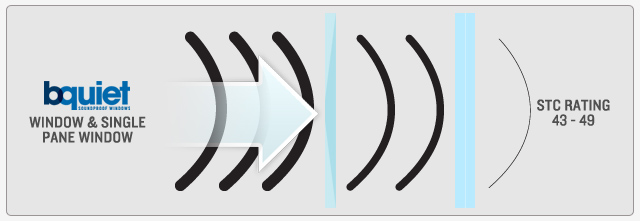

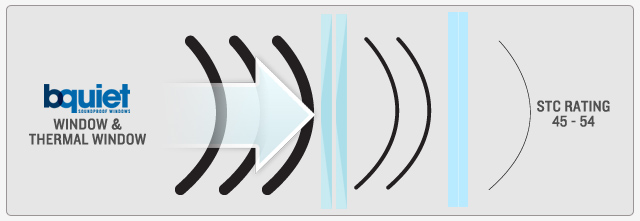

Triple Glazed Windows Facts
Triple glazing is often recommended for noise reduction by most regular window companies. Unfortunately, they do not have the soundproofing expertise, and they don’t offer refunds when it doesn’t work. Here is a quick summary of triple-glazed windows and soundproofing.
- Noise Reduction: The soundproofing capabilities of triple-glazed windows are only marginally better, if at all, than double-glazed windows. The closer spacing of the glass panes in triple-glazed windows limits the effectiveness of the additional glass layer in terms of noise reduction. Sound reduction is largely achieved through both density (thickness of the glass) and the space between the panes. So, the closer the panes are spaced and the thinner the glass, the less effective the soundproofing becomes.
- Thermal Insulation: Excellent thermal insulation makes triple glazing a great choice for energy efficiency and managing cold temperatures in the winter if noise is not a concern.
- Cost: Triple-glazed windows are more expensive than double-glazed windows and have size limitations due to their extra weight.
- Installation: Installing triple-glazed windows requires the complete removal of existing window frames, which can be a disruptive and time-consuming process. bquiet Soundproof Windows are easily installed inside the existing window jamb with no mess or disruption.
Exterior Walls
Walls have an STC rating ranging anywhere from 50-70. Most houses in Northern climates have more stringent building codes. Walls have to meet high R factors to provide good insulation. This also provides higher STC ratings – a well insulated home in a Northern climate has walls with STC ratings in the 60’s. This is the case in most of Canada and the Northern U.S. Therefore, if your walls have an STC of 65 and your thermal windows are 28, then all the noise you are hearing is through the windows. Increasing the STC rating of the windows so they perform similarly to the wall is the most effective strategy in reducing exterior noise.
Want to Learn More?
Contact us today to find out more about the benefits of soundproof windows.